
In 1995, the U.S. Mint produced 25-cent coins featuring George Washington at three facilities: Philadelphia (P), Denver (D), and San Francisco (S).
The total mintage exceeded 2.1 billion specimens, including the 1995 quarter errors.

High minting intensity led to specific defects presenting financial interest to numismatists.
The price of such specimens is determined by the Sheldon scale ranging from 1 to 70 points.
Error Type | Condition (Grade) | Approximate Value ($) | Record Price ($) |
Double Die Obverse (DDO) | MS65 | 50 – 150 | 450+ |
Off-Center Strike (10-25%) | MS63 | 40 – 100 | 250 |
Broadstrike | MS64 | 20 – 60 | 120 |
Wrong Planchet Error | MS60+ | 500 – 1500 | 3000+ |
Clipped Planchet | MS63 | 15 – 45 | 100 |
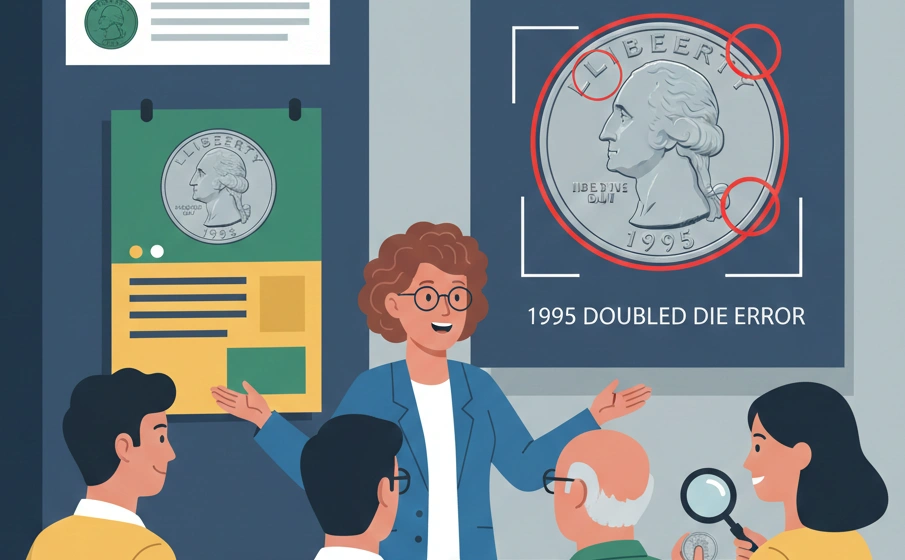
1995-P Double Die Obverse (DDO)
This defect occurs during the production of a working die receiving a double impression from the hub.
On the obverse of the 1995 Philadelphia mint coin, the doubling of letters in the motto "IN GOD WE TRUST" and the word "LIBERTY" is most noticeable.
Examining the surface through the best coin value app, one can find clear additional contours on the serifs of the letters.
In 2023, a specimen in MS66 condition was sold at auction for 432 dollars.
Sales statistics over the last 5 years demonstrate an annual price increase of 4-6% for this error type resulting from the gradual removal of coins from circulation.
Off-Center Strikes
The displacement of the planchet relative to the die leads to the partial absence of the image on one side.
Coins having a displacement of less than 5% lack high numismatic value.
Specimens with displacement ranging from 20% to 50% retaining the date of issue are the most sought-after lots.
A 1995-P variant with a 25% offset at the "6 o'clock" position in MS64 condition is valued at 150–200 dollars.
Increasing the displacement to 60%, the price stabilizes due to the lack of a date reducing the asset's liquidity by 30-40%.
Broadstrike Errors
This defect appears upon the failure of the retaining collar at the moment of the die strike.
The planchet metal expands uncontrollably, increasing the coin's diameter and stripping the edge of its reeding.
1995 coins possessing this feature must retain all design details within the expanded rim.
The average auction price for an MS65 specimen stands at 75 dollars.
The inflation rates of the numismatic market for this segment amount to 3% per year.
Wrong Planchet Errors
The rarest and most expensive type of 1995 error involves using planchets intended for other denominations.
Cases of minting 25-cent designs on 10-cent (Dime) planchets have been recorded.
Such a coin has a lower weight (2.27 g versus the standard 5.67 g) and a smaller diameter.
The cost of similar lots on major platforms, such as Heritage Auctions, starts from 1200 dollars.
The investment attractiveness of this asset is confirmed by a 12% price increase over the 2018–2024 period.
Condition and Price
Luster Retention. The presence of original mint luster increases the price by 20–50% compared to dull specimens.
Absence of Mechanical Damage. Scratches received during circulation reduce the value of a defective coin by 60%.
Date Clarity. The absence or blurriness of the "1995" digits makes the error unidentifiable by year, lowering buyer interest.
Certification (NGC/PCGS). The presence of a slab increases the market value 1.5–2 times by confirming authenticity.
Or you can use a coin scanner app for free to check the coin.
Price Dynamics for 1995 Quarters 2015 - 2025
Mathematical analysis of market trends shows the following changes.
2015-2018: A stable period with price fluctuations within 2%.
2019-2021: Increased demand for Double Die errors causing a 15% price spike.
2022-2024: Market correction stabilizing prices for common errors (Clipped Planchet) while maintaining a shortage of Wrong Planchets.
The projected increase in value for rare error types in 2025 is approximately 5.5% assuming economic stability remains.
Die Cracks and Cuds
Die cracks leave raised lines on the coin's surface.
If a piece of the die breaks off completely, a non-distinct metal protrusion forms on the coin.
Minor cracks in the area of Washington's head are characteristic of the 1995 issue.
The value of such specimens is small, rarely exceeding 10–15 dollars.
Large "Cuds" covering a significant part of the date or letters are exceptions, potentially raising the price to 50–80 dollars.
So, to accurately determine the value of a 1995 coin with a defect, one must perform the following actions.
Check the coin's mass on electronic scales with an accuracy of 0.01 g.
Examine the edge for the presence of a copper layer (for standard quarters).
Compare the discovered doubling with confirmed samples in CONECA registries.
Estimate the percentage of image displacement if an Off-Center error is present.
Utilizing these tools allows for avoiding the purchase of counterfeits created outside the U.S. Mint walls.
Confirmed facts indicate that the 1995 quarters remain an accessible yet profitable segment for monitoring in modern U.S. numismatics.
Popular

Exploring Advanced Threat Detection Techniques Used by Antivirus Programs
In today's digital age, the threat of cyber attacks and malware infections is ever-present. With the increasing sophistication of hackers and malicious software, it is more important than ever to have...

Phishing Scams: Spotting the Red Flags and Staying Safe
Learn how to identify the red flags of phishing scams and protect yourself from cyber threats. Explore key strategies for individuals and businesses to spot phishing attempts and implement robust secu...

Cyber Shield: Top Strategies to Fortify Your Digital World Against Threats
Discover essential strategies to protect your data and systems from cyber threats. Learn how to implement cybersecurity best practices, strengthen infrastructure, and build a robust defense with this ...

Hack-Proof Your Devices: A Beginner’s Guide to Bulletproof Computer Security
Learn essential tips to hack-proof your devices and protect your data. From strong passwords to network security and backups, this beginner's guide covers all you need to fortify your cybersecurity. S...

1995 Quarter Errors: Mint Mistakes Worth Money
Detailed technical analysis of 1995 Washington Quarter minting errors, including Double Dies, Off-Center strikes, and Broadstrikes with verified auction records....